
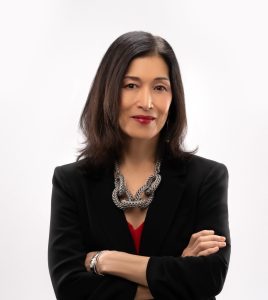
Mari Horita 2025. Photo by Alabastro Photography.
Nestled in Seattle’s Northgate neighborhood, the Seattle Kraken and their skilled administrative team run a massive local operation.
When you arrive at the team’s offices, friendly dogs wearing Kraken gear may greet you with the politest of wagging tails, their owners smiling at you as you pass by; as you leave, you’re likely to be offered free range of the candy jar on the front desk. There is a humanity and friendliness, a pointed warmth in a profession that specializes in ice.
In the Kraken’s office, you’ll find Senior Vice President of Social Impact & Civic Affairs and Executive Director of One Roof Foundation Mari Horita, a SYSO alumna, hard at work with her team building strategy and delivering a community-oriented vision for the local giant.
From Eckstein Middle School and Roosevelt High to years in law, to a career spent as a leader in arts philanthropy, Mari Horita carved a unique and meaningful space for herself as a Seattle-based leader and advocate.
–
DRIVE IN LIFE FORGED AT SYSO
Like many string musicians, Horita studied tried-and-true teaching methods to develop her early understanding of music, which, over time, became her toolbox for building a deep appreciation for it.
“I started as a Suzuki violin player, like many people did, when I was six years old, then kept playing. I played in SYSO when I was a freshman, sophomore, and junior. I did Little (now Debut), Junior, and Youth Symphony.
“My favorite memory was playing Mahler 10. I was 14, I was in the second violin section. I had never been more moved by a piece of music. It was life-changing, and I became a die-hard Mahler fan. Something like that you don’t really forget.”
By the time Horita was a senior in high school, she knew music had to be a big part of her life. She opted to spend her senior year traveling up to Vancouver, B.C., for weekly lessons with renowned violin instructor Gwen Thompson, a faculty member at the Vancouver Academy of Music. That year, she played with an orchestra in Vancouver.
For undergraduate studies, Horita enrolled at Pomona College in Southern California, and while she didn’t major in music, she was determined not to lose her connection to it. “One of the people [in my class] was a violist, so we formed a quartet called the ‘Orfeo String Quartet,’ and became the resident string quartet at Pomona College. They didn’t have one, so we occupied that empty space.”
Horita later completed a JD program at the University of Washington, but decided pretty soon after working in the industry that law wasn’t her long-term plan. Horita found her sense of belonging in the work of non-profit organizations, energizing advocacy to better the city she’d called home for most of her life.
“You know how sometimes we fall into things and we decide whether we really like them or we really don’t? I liked the intellectual rigor of law. It trains—at least it did for me—how to write and how to communicate. But it wasn’t inspiring to me. What was inspiring was doing non-profit board work.”
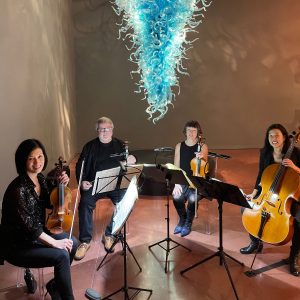
Mari Horita (left) performing with her quartet.
–
NONPROFITS, ARTSFUND, & SEATTLE’S CULTURAL SCENE
Horita’s journey to her profession is one of those age-old reminders that, by staying open to new possibilities, one’s life trajectory can change in exciting and unexpected ways.
“I kind of fell into [nonprofits] because someone said they needed a general counsel at the Japanese American Chamber, so I signed up, and there was Tomio Moriguchi and Scott Oki—and I just felt like an imposter.
“But I started learning about the sector, these causes, and all these different issues happening in our society and world, and it was really interesting to me. Everyone needs their purpose, their drive, and for me, it was that type of work.”
Though uncharted territory to Horita, her years spent volunteering at nonprofits developed her passions, starting her on a path that one day led her to an opportunity to lead Seattle-based funding giant ArtsFund as its CEO.
ArtsFund is focused on enlivening our local bustling arts culture through grantmaking and resource sharing with nonprofits. Horita would devote 7 years to ArtsFund, remaining laser-focused on how the funding giant could do things differently to set itself apart.
“ArtsFund funded organizations that had ‘professional’ artists, not youth artists. I don’t think it was a values thing, I think it was probably because that’s what had always been done.”
Horita saw the organization’s opportunity right in the tradition she herself grew up in as a SYSO musician—youth arts access. “We started the Youth Arts Opportunity Fund.”
Steering a funding arm as large as ArtsFund’s came with its share of struggles, too, particularly in how arts philanthropy presents a complicated “this-or-that” dichotomy in the public eye when posited next to more pressing areas of need.
“When you look at everything going on in the world—people living in tents, people overdosing on the streets, public safety being an issue, our educational outcomes being worse even though more money is being poured into it, climate change—there are so many issues in the world that are horrible…they’re real and pressing for a lot of people.”
The “ask” for supporting the arts that Horita mastered was informed by a dose of reality, and by not shying away from the fact that some issues will rightfully tug on our collective consciousness with greater urgency.
“The challenge I saw when I was at ArtsFund was saying, “I get it: Yes, support these causes that mean a lot—but can you support the arts, too?’ ”
–
COMMUNITY-ORIENTED, KRAKEN STYLE
At the Kraken, in a time marked by growing hostility toward identity politics and the bulk of the popular socio-political trends in the US from the past decade and a half, Horita and her team have to source and present their activism thoughtfully.
“Fans want to have a good time. I get it—people don’t want to be lectured when they come to a game, they want to have a good time, so we need to find a way to balance it and still raise important issues.
“We celebrate communities, we stand for things, we believe we are the most inclusive hockey team in the world, and intentionally so. We celebrate nonprofits at every game, we make donations, we uplift stories…[Fans] come to be uplifted, we don’t shame people.”
If the Kraken seem to have mastered how they breezily incorporate community storytelling into their work, that’s because their Social Impact department has been there since the franchise’s inception. This foundation sharpened them to more succinctly occupy a unique space as a community-focused endeavor in the industry.
But it didn’t always feel seamless to Horita, and she’ll share willingly how much of an outsider to the sport she considered herself before she joined the Kraken. She’ll also show gratitude for a working environment where she feels permission to do work that matters in earnest, built through the joint efforts of a strong team.
“I didn’t know hockey at all. I was one of the first 20 employees…Tod Leiweke, our CEO, is amazing, one in a million. He came back to Seattle to build this enterprise to do something very powerful and positive. Hockey is a vehicle, but his vision is bigger. That’s what inspired me: I can be a part of this, I can help build something from the ground up.”
–
 ACTIVISM: CHANGE BEYOND A SCREEN
Today’s youth can access worlds of politics and social justice with great freedom and relatively unrestricted access to information—that, combined with the fact that most of that content is received through a screen, creates a dilemma in practice.
“I think it’s wonderful that youth get engaged. It’s critical that youth get involved with politics, advocacy, civil engagement, and that they’re informed.
“It’s important for all of us, of any age, to reflect on why we are doing something on behalf of a cause. Is it to make ourselves feel better, or is it to actually help advance the cause? Figure out what the problems are, go into the world, go to Olympia—but don’t advocate on your phone.”
Alongside her work with the Kraken, Horita recently began offering her support to our city government, serving on Mayor Wilson’s transition team.
“[Mayor Wilson’s transition team] is 60 people divided into 7 different areas. My area is on Civic Narrative and big-picture issues. We’ve been getting feedback from people who have really tried to build this city over the last 50 years.
“There are many different civic narratives about Seattle right now—some are good, some are bad, and they’re all probably a little bit true. The civic narrative that we aspire to achieve is one where we have more than the natural beauty, more than the innovative companies fueling our economy, that we have one of the best sports communities in the country, and that we have this thriving arts community—it’s all part of one thing.
“It’s an ecosystem–we need everyone committed to our shared success, in sports, arts, affordability, public safety, innovation, business, cross-sector partnerships… We need to restore community cohesion and civic pride.”
–
Whether or not a SYSO musician goes on to become a professional musician, oftentimes their love of music is so profound by the time they graduate from SYSO that music becomes a long-term part of their life stories.
That’s true for Horita, who today plays alongside fellow SYSO alumni parents in a string quartet. It’s just one way, in addition to partaking in the incredible scene of arts and culture Seattle serves up on a regular basis, that Horita keeps her love for music alive.
To a new SYSO musician, Horita encourages any student to take advantage of their moment and to never lose their sense of assurance.
“You got there, you earned it, you worked hard to be there. Have that confidence, believe in yourself. Give it your all, enjoy the privilege, opportunity, and the unique experience, because it is something that still sticks with me, and I’m grateful to have been part of it. Enjoy the moment and know that you should be there, you belong there.”


